Posts

Commission on Federal Election Reform, founded in 2004 by former US President Jimmy Carter and James A. Baker, III,

Image
The commission continued work begun by Carter and former President Ford in a previous commission that studied unusual features of the 2000 presidential race. Its mandate was to examine the electoral process in the United States, bringing together leaders from the major political parties, academia, and non-partisan civic groups to explore how to maximize both ballot access and ballot integrity. The panel suggested 87 recommendations in all in its 91-page report. Implementation of all suggestions would require congressional action for some measures, as well as a total expected cost of $1.35 billion. A major point was the commission's call for nonpartisan professional and state oversight over elections. The panel noted that both the 2000 and 2004 elections were marred by partisan, campaign-affiliated officials who held roles in the Bush campaign and Florida and Ohio Secretary of State positions. Because the Secretary of State is responsible for certifying votes, these conflicts...
Beaker culture

Image
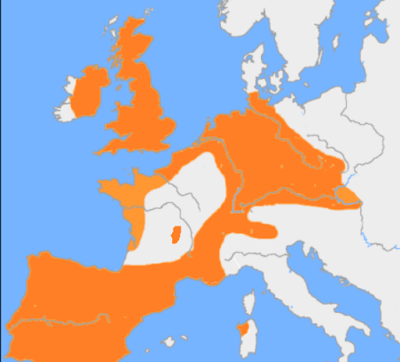
The Bell Beaker culture was partly preceded by and contemporaneous with the Corded Ware culture, and in north-central Europe preceded by the Funnelbeaker culture. Named after the inverted-bell beaker drinking vessel used at the very beginning of the European Bronze Age. Arising from around 2800 BC, it lasted in Britain until as late as 1800 BC. This period marks a period of cultural contact in Atlantic and Western Europe following a prolonged period of relative isolation during the Neolithic. In its mature phase, the Bell Beaker culture is understood as not only a collection of characteristic artefact types, but a complex cultural phenomenon involving metalwork in copper and gold, archery, specific types of ornamentation, and (presumably) shared ideological, cultural and religious ideas. A wide range of regional diversity persists within the widespread late Beaker culture, particularly in local burial styles (including incidences of cremation rather than burial), housing styles, ec...

Kurgan theory or Kurgan model) or Steppe theory is the most widely accepted proposal to identify the Proto-Indo-European homeland from which the Indo-European languages spread out throughout Europe and parts of Asia.

Image
The people of these cultures were nomadic pastoralists, who, according to the model, by the early 3rd millennium BC had expanded throughout the Pontic–Caspian steppe and into Eastern Europe.The Kurgan hypothesis, first put forward in 1956 by Marija Gimbutas, has become the most popular. It proposes that the original speakers of PIE were the Yamnaya culture associated with the kurgans (burial mounds) on the Pontic–Caspian steppe north of the Black Sea. According to the theory, they were nomadic pastoralists who domesticated the horse, which allowed them to migrate across Europe and Asia in wagons and chariots. By the early 3rd millennium BC, they had expanded throughout the Pontic–Caspian steppe and into eastern Europe . Three genetic studies in 2015 gave partial support to Gimbutas's Kurgan theory regarding the Indo-European Urheimat. According to those studies, haplogroups R1b and R1a, now the most common in Europe (R1a is also common in South Asia) would have expanded from...

Y Wladfa,

Image
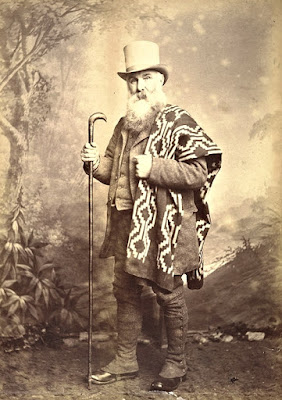
The Rev. Michael D. Jones (1822–98) He proposed setting up a Welsh-speaking colony away from the influence of the English language. He recruited settlers and provided financing; Australia, New Zealand and even Palestine were considered, but Patagonia was chosen for its isolation and the Argentines' offer of 100 square miles (260 km2) of land along the Chubut River in exchange for settling the still-unconquered land of Patagonia for Argentina. Patagonia, including the Chubut Valley was claimed by Buenos Aires but it has little control over the area which was also claimed by Chile.[10]:23–30 Michael D Jones had been corresponding with the Argentinean government about settling an area known as Bahía Blanca where Welsh immigrants could preserve their language and culture. The Argentinean government granted the request as it put them in control of a large tract of land. A Welsh immigration committee met in Liverpool and published a handbook, Llawlyfr y Wladfa, to publicize the sche...

SDS developed from the Student League for Industrial Democracy (SLID), the youth branch of a socialist educational organization known as the League for Industrial Democracy (LID). LID descended from the Intercollegiate Socialist Society, started in 1905. Early in 1960, the SLID changed its name into Students for a Democratic Society (SDS). The Port Huron Statement was adopted at the organization's first convention in 1962 based on an earlier draft by staff member Tom Hayden.

The Port Huron Statement[4] decried what it described as "disturbing paradoxes": that the world's "wealthiest and strongest country" should "tolerate anarchy as a major principle of international conduct"; that it should allow "the declaration 'all men are created equal...'" to ring "hollow before the facts of Negro life"; that, even as technology creates "new forms of social organization", it should continue to impose "meaningless work and idleness"; and with two-thirds of mankind undernourished that its "upper classes" should "revel amidst superfluous abundance". In searching for "the spark and engine of change" the authors disclaimed any "formulas" or "closed theories." Instead, "matured" by "the horrors of a century" in which "to be idealistic is to be considered apocalyptic", Students for a Democratic Society would seek ...

Urraca (April 1079 – 8 March 1126) called the Reckless (la Temeraria),[1] was Queen of León, Castile, and Galicia from 1109 until her death. She claimed the imperial title as suo jure Empress of All Spain[2] and Empress of All Galicia.[

The most famous proponents of independence were Gonzalo Peláez and Queen Urraca, who, while achieving significant victories, were ultimately defeated by Castilian troops. After its integration into the Kingdom of Spain, Asturias provided the Spanish court with high-ranking aristocrats and played an important role in the colonisation of America. Since 1388, the heir to the Castilian (later Spanish) throne has been styled Prince of Asturias. In the 16th century, the population reached 100,000 for the first time, and within another century that number would double due to the arrival of American corn. The Astures were subdued by the Romans but were never fully conquered. After several centuries without foreign presence, they enjoyed a brief revival during the Germanic invasions of the late 4th century AD, resisting Suebi and Visigoth raids throughout the 5th Century AD, ending with the Moorish invasion of Spain. However, as it had been for the Romans and Visigoths, the Moors did not find ...

My Many Hurried Southern Trips

Image